
Categories
Ecology Progress Social Impact Sustainability

100 Kilograms of Legumes

Reading Time: 5 minutes.

A couple of days ago, I woke up with an intuitively received phrase: “100 Kilograms of Legumes”. I wondered what the message was about. Was it about taking a measurable action to help people in need? Was it about launching a fundraising campaign where people could take action? Or was it about getting protein-rich food for myself and my kids to save money on food?

Legumes are plants that produce seeds inside pods. The edible seeds are a major source of protein, fiber, vitamins, and minerals. Common legumes include lentils, peas, chickpeas, kidney beans, black beans, soybeans, and peanuts.

After checking with ChatGPT, I learned that one can make 1,500 meal portions from 100 kilograms of dry lentils, chickpeas, or other legumes. That could be a couple of weeks of nutrition for 100 people in need, or lunch for a small family of four for the whole year. The cost of 100 kg of legumes is between 250 and 500 EUR.

This intuitive message, combined with ChatGPT research, led to more rational posts on my Instagram feed and pushed me into a more analytical mindset for the rest of the day. As a result, I later started analyzing the sustainability of the donation platform I am building: make-impact.org.

make-impact.org – what is it about?

Make-Impact.org is going to be a centralized European donation platform that inspires and enables people to support the causes they care about most. By making charitable giving more engaging, transparent, and accessible, the platform aims to increase support for humanitarian and development aid projects across Europe and beyond.

I believe that businesses are the primary drivers of progress, innovation, and economic growth. However, progress often comes with unintended negative consequences. For example, the production of plastic has made many useful goods affordable and accessible worldwide, but the resulting waste now fills landfills and harms wildlife. Similarly, advances in AI have improved productivity and accelerated information exchange, but they have also made some jobs obsolete, creating a need for retraining and education.

These side effects of progress do not disappear on their own; they need to be addressed. While businesses are often the driving force behind progress, it is usually cause-oriented organizations that deal with the damage left behind, whether environmental, social, or humanitarian.

There are also many initiatives that meaningfully improve human well-being while remaining largely unrecognized, such as community centers, public parks, urban gardening initiatives, open-source projects, Wikimedia, public art funds, museums, and libraries.

I believe that donations should not be forced by law, but rather based on awareness, free will, and financial strength. People need a clear way to understand where help is needed in this complex system, and how they can actually contribute. Make-Impact.org should clearly show real-world problems and make it easy to understand how much money is needed to solve them. It connects awareness with action, so people don’t just see the issues, but also know how to respond in a meaningful way.

The project is a few times larger than my current capacity to manage, but over time I hope to meet the right people to help me launch and run it. My current goal is to implement it technically within the next 6–12 months on weekends, and see where it leads: “The way will show the way”.

Conversion from visitors to donors

The estimate is 100,000 to 300,000 donations per year via Make-Impact.org. That would be roughly 275 to 820 donations per day.

Let’s see how many visits a website would need to handle to support that number of donations.

  • Visits from search engines or social media of uninformed users (so-called cold traffic) often result in a 0.1%–1% donation conversion rate.
  • Highly targeted visitors who already intend to donate: 1%–5%+ is possible.
  • Returning users and supporters of specific causes can convert even higher (and that will be the main goal of the platform).

To reach 100,000–300,000 donations/year, the platform would need roughly:

  • At 0.5% conversion: 55,000–164,000 visits/day
  • At 1% conversion: 27,500–82,000 visits/day
  • At 2% conversion: 13,750–41,000k visits/day

27,500 visits/day is approximately 19 visits per minute, or 1 visit every 3 seconds on average.

Conversion from one-time donors to recurring donors

The platform should support both one-time and recurring donations. Non-profits often prefer recurring donations because they allow better long-term planning.

Recurring donors also tend to stay engaged much longer than one-time donors. On average, they remain active for about 5 to 8 years, compared to just 18 months for one-time donors.

Another study found that the average lifetime of recurring donations is about 7.77 years, and up to 77% of recurring donors continue donating year over year.

Therefore, the goal of the platform is to optimize engagement so that users either choose recurring donations or regularly return to support causes. Openness, transparency, gamification, respectful communication, mailing lists, and collaborative campaigns could all help achieve this.

Technical infrastructure

The platform can be monolithic at first, hosted on a single server. This minimal setup could cost around 40 to 100 EUR per month, including domain, web server, database, media storage, email provider, and backups.

The server can scale vertically by adding more CPU and RAM. However, at some point, traffic will grow too large and performance may degrade.

When the number of donors reaches hundreds of thousands, it is recommended to switch to a serverless or multi-server architecture (likely using Docker and Kubernetes). At that stage, monthly costs could exceed 1,000 EUR.

Money transfers would likely be implemented using Donorbox or Betterplace integrations, or by redirecting users directly to non-profit websites, which ideally would notify Make-Impact.org about transactions via webhooks or a REST API.

Typical donation sizes in Europe

Donation amounts vary by country based on average income, cost of living, familiarity with recurring giving models, trust in online donation systems, and tax incentives.

In many platforms, the average one-time donation is around 20–60 EUR. A typical recurring donation is 5–20 EUR per month. People in Southern and Eastern Europe tend to donate smaller amounts per donation compared to those in Northern and Western Europe.

Northern and Western European countries like Germany, the Netherlands, and Sweden generally show higher average donation sizes due to higher income levels and a stronger donation culture.

Common one-time donations:

  • 20–50 EUR — very typical online range
  • 50–150 EUR — common for strong engagement (campaigns, disasters)
  • 150–500+ EUR — occasional major gifts

Recurring donations:

  • 10–25 EUR/month — very standard
  • 25–50 EUR/month — strong supporters

In Southern European countries such as Italy, Spain, and Portugal, disposable income is generally lower.

Common one-time donations:

  • 5–20 EUR — very common online range
  • 20–50 EUR — engaged donors
  • 50–100+ EUR — less frequent

Recurring donations:

  • 3–10 EUR/month — entry-level recurring support
  • 10–20 EUR/month — committed donors

In Eastern European countries such as Poland, Romania, Bulgaria, and Hungary, incomes are also lower, which is reflected in donation amounts.

Common one-time donations:

  • 3–15 EUR — frequent online range
  • 15–40 EUR — strong engagement
  • 40–100+ EUR — less common

Recurring donations:

  • 2–8 EUR/month — typical range
  • 8–15 EUR/month — strong supporters

Marketing

At an early stage, acquiring a new donor usually costs between 50 and 250 EUR, depending on how people are reached and in which region. Online campaigns are often cheaper, while direct outreach or in-person methods tend to be more expensive. For Make-Impact.org, a realistic starting point would be around 50 to 100 EUR per new donor per year. If some of them become recurring donors, their lifetime value can grow beyond 120 EUR per person.

Customer acquisition cost is quite high compared to average donation sizes. The math is not mathing yet, but there are ways to improve it.

Some ideas:

  • Short, emotional videos can be very effective — people respond strongly to impact stories. AI-based storytelling could also combine raw data into more compelling narratives.
  • Partnering with brands or companies where employer matching or rewards amplify donations.
  • Gamification: milestones, progress bars, or friendly leaderboards to increase engagement.
  • Shareable challenges, such as a “7 Days of Giving” campaign.
  • Collaborating with influencers or micro-influencers aligned with the mission.

Funding

I am looking for long-term funding options so that taking commissions from donations is not necessary. Make-Impact.org should remain open, transparent, and informative to build trust. Any ideas are welcome.

Final words

Take the numbers here with a grain of salt, just like a dish of legumes. ChatGPT might be hallucinating or estimating based on limited data from a few countries. Still, this overview gives a better sense of what might be ahead for this project.

Wish me luck, and join the waitlist.


Cover picture by Adrianna CA

Categories
Life Progress Self-awareness Spirituality

Mindware: Influences on My Inner Operating System

Reading Time: 4 minutes.

Lithuanian polymath Tomas Jonas Girdzijauskas has said once that every man must develop his own Operating System – the core structure and mechanism on how he perceives the world. The Operating System of my worldview is based on many different influences. Still, at its core, I see the philosophies and paradigms of three men who analyzed the human mind and spirit. They are Ken Wilber, David R. Hawkins, and Carl Jung.

Ken Wilber – Integral Theory

I learned about Ken Wilber through a Mindvalley webinar, read online about his theories, watched another webinar that illustrated his theories by themes in movies, and watched a biographical depiction of his love life, titled “Grace and Grit.”

At a young age, Ken Wilber studied lots of philosophies and religions, and combined what he learned into Integral Theory. He defines stages of personal development, ranging from the physical self to the godly self, and assigns colors to each stage, progressing from infrared to clear light. Human consciousness evolves from being ego-centric to caring about one’s close ones, then about their communities, their city, their country, their continent, their planet, all living physical beings, and non-physical ones too.

There are many aspects to explore in Ken Wilber’s Integral Theory, and I may delve into his books at a later stage of my maturity.

For those curious about me, in the past couple of years, I transitioned from Turquoise to Indigo as my baseline – the first level of spiritual awareness. I have encountered the most resistance from people at the Amber level during my growth.

David Ramon Hawkins – Kinesiology

I learned about David R. Hawkins from a Lithuanian Facebook group focused on consciousness, which cited his book. As the texts resonated with me a lot, I purchased the mentioned book, Power vs. Force. An Anatomy of Consciousness-and it was another eye opener for me.

David R. Hawkins analyzed how kinesiology can help you read your intuition. The idea is that people are connected to a common consciousness field, which can be read from by checking the strength of muscle tension. The mind might doubt or lie due to various biases, but the body feels the field more strongly. There are different muscle tests to check the truthfulness of your true-false statements. Some checks I would start with: “My name is …”. Insert your name and the other person’s name there, and see the difference in your muscle strength. Then, check the statements “I am a body” and “I have a body.”

Eventually, those muscle tests fail too, especially when you are sceptical. However, using those methods, David R. Hawkins deciphered and evaluated consciousness levels with their frequencies ranging from 1 to 1000. That has a similarity to Ken Wilber’s consciousness levels. Hawkins’ consciousness levels address different emotions as the baseline of what a person feels every day. At the bottom of the scale are shame (20), guilt (30), apathy (50), and grief (75). At the top are love (500), joy (540), peace(600), and enlightenment (700-1000).

At some point in my life, while having the consciousness map in front of me, I could empathetically recognize at which frequency a person is currently living.

Carl Gustav Jung – the Shadow

I learned about Carl Jung from an artistic and technical friend, then watched a few introductory YouTube videos, such as comparisons with Buddhism, listened to the This Jungian Life podcast, and read some related threads on X.

The main idea of Carl Jung’s theories was that a person has their conscious thinking and a persona as a chosen representation to others, as well as a significant shadow side (unconscious), hiding all the suppressed beliefs about themselves and past traumas.

For example, one of the topics of the unconscious is how a person perceives the archetypical masculinity and femininity in themselves. 

In society, a lot of humor is based on the assumption that a man is manly and a woman is womanly, and if one has any features of the opposite sex, it’s something to laugh about. But in reality, every one of us has features of both sides; however, some people suppress the features they don’t want to show and accept.

Carl Jung also defined character archetypes: the Hero, the Mentor, the Explorer, the Lover, the Caregiver, the Rebel, the Jester, the Ruler, the Innocent, and the Sage. These archetypes are often used to define personas in marketing. You can recognize similar profiles at 16personalities.

How it all comes together

You can’t get to the surface of the water if you are carrying stones in your pockets.

– Me on socials

As we live at a particular consciousness level as our baseline, we usually have suppressed traumas from the past that raise fears and insecurities about growing into the next levels of consciousness.

By getting into an emotionally safe space and then meditatively going back to the past in memories and re-experiencing the first occurrences of the events that blocked us later in life, we can send energy, love, and understanding to the past version of self, to dissolve the emotional tensions and get free from that trauma that shaped how we react to similar events later in the lifetime. It’s called shadow work, and it’s not as easy as it sounds, especially with the heaviest experiences. However, the more we work on that, the healthier, more loving, and peaceful our life gets later in the future.

By starting to care about bigger and bigger groups of people, we raise our consciousness, increase our responsibility, and create or recall larger missions for why we are here and what we are supposed to do here, or how important it is what we do in the overall journey or grand scheme.

[…] we will see that power arises from meaning. It has to do with motive and it has to do with principle. Power is always associated with that which supports the significance of life itself. It appeals to that in human nature which we call noble, in contrast to force, which appeals to that which we call crass. Power appeals to that which uplifts and dignifies-ennobles. Force must always be justified, whereas power requires no justification. Force is associated with the partial, power with the whole.

– David R. Hawkins

Categories
Life Self-awareness

If Aliens Made Clones of You…

Reading Time: < 1 minute.

If aliens made 100 clones of you with your skills, knowledge, attitude, and mindset, would the world be a better place to live or worse?

👽👽👽

Press, radio, TV, and social media are precisely clone-making machines.

Each of us resonates with what we consume.

👤 ➔ 📺📻📱 ➔ 👥👥👥😉👥👥👥

We have a conscious or unconscious tendency to copy who resembles us.

That’s called homophily (“love of being alike”).

👥👥👥 ❤️ 😉 ❤️ 👥👥👥

For example, people may be more likely to follow trends or form friendships, romantic relationships, or professional connections with individuals who share interests or have similar educational backgrounds at similar times.

👩‍🎓🧑‍🎓😉👨‍🎓👩‍🎓

Our network shapes us, and we shape our network as well. We copy not only our relatives and friends but also friends of friends and friends of friends of friends.

😉 ⇄ 👤 ⇄ 👤

You are connected to anyone on Earth by 6 degrees of separation: your friend is 1 degree from you, the friend of your friend is 2 degrees, and so on.

But we have influence and are influenced by 3 degrees on average.

😉 ⇄ 👤 ⇄👤 ⇄ 👤 ⋯ 👤 ⋯ 👤 ⋯ 👤

If you have 120 acquaintances, and each of them has 120 acquaintances, and each of those has that many, too, you can imagine how many people you may influence just by your presence.

And if you are on social networks, you probably have way more friends than 120.

🕸🕸🕸😉🕸🕸🕸

So, a few questions for you:

  • Does this make you feel paralyzed or more responsible for your actions?
  • Do your actions match your virtues?
  • Are you living your best self?

🦸‍♀️🦸🏻‍♂️🦸🏽‍♀️😉🦸🦸🏿‍♂️🦸🏻‍♂️

This information was strongly influenced by the book “Connected” by Nicholas Christakis, MD, Ph.D., and James Fowler, Ph.D.

😉📙


Cover photo by cottonbro studio.

Categories
Ecology Life Sustainability

17 Django Project Ideas that can Make a Positive Impact around You

Reading Time: 4 minutes.

This post first appeared on the DjangoTricks blog.

For more than a decade, I was focused only on the technical part of website building with Django. In the process, I have built a bunch of interesting cultural websites. But I always felt that those sleepless nights were not worthy of the impact.

They say, “Don’t work hard, work smart!” I agree with that phrase, and for me it’s not about working less hours. For me, it’s working as much as necessary, but on things that matter most.

So after years of collecting facts about life, I connected the dots and came up with make-impact.org – a social donation platform, which became one of the most important long-term projects. All my planning goes around this project.

And I believe I am not the only programmer who sometimes feels that they want to make a positive impact with their skills. So I brainstormed 17 Django project ideas. You can choose one and realize it as a hobby project, open-source platform, startup, or non-profit organization; alone, with a team of developers, or collaborating with some non-technical people.

Idea #1: Low Qualification Job Search

The job market is pretty competitive, and not all people can keep up with the train. You could build a job search website for jobs that don’t require high education or lots of working experience. It could be helpful for people with language barriers, harsh living conditions, or those who are very young or very old. You could build it for your city, region, or country.

Idea #2: Discounted Meals and Products

Get inspired from Too Good To Go and build a progressive web app for your city about discounted restaurant meals and shop products whose expiration date is close to the end, but they are still good to eat.

Idea #3: Personal Health Advisor and Tracker

Build a website for setting your personal health improvement goals and tracking the progress. For example, maybe one wants to start eating more particular vegetables every week, jogging daily, lose or gain weight, or get rid of unhealthy addictions. Let people choose their health goals and check in with each progressive step. Allow using the website anonymously.

Idea #4: Online Primary and Elementary School Materials

Some people don’t have access to schools in general or miss some classes because of illnesses. You could build a global and open wiki-based primary and elementary school education website for children and adults. It should be translatable and localizable. It would also be interesting to compare the same subject teachings in different countries side-by-side.

Idea #5: Psychological Support for Women

You could build a website with a video chat providing psychological support to discriminated or violently abused women. The help could be given by professionals or emphatic volunteers. The technical part can be implemented using django-channels, WebSockets, and WebRTC.

Idea #6: Rain-harvesting Companies around the World

Rain harvesting is one of the available ways to solve the problem of the lack of drinking water. There could be a platform comparing rain-harvesting companies all around the world. What are the installation prices? What are the countries they are working with? How many people have they saved? This website would allow people to find the most optimal company to build a rain harvesting system for them.

Idea #7: Closest Electric Car Charging Stations

Use the Open Charge Map API and create a progressive web app that shows the nearest electric car charging station and how to get there.

Idea #8: Escrow-based Remote Job Search

As remote jobs are getting more and more popular, there is still a matter of trust between the employees and employers. “Will the job taker complete their job in a good quality?” “Will the company pay the employee on time?” There are Escrow services to fix this issue. These are third parties that take and hold the money until the job is done. You could build a remote job search website promoting the usage of Escrow.com or another escrow service provider.

Idea #9: Open Work Locations

You could build a website listing coworking spaces and cafes with free wifi in your city. It should include the map, price ranges, details if registration is required, and other information necessary for remote workers.

Idea #10: Most Admired Companies

There could be a social website listing the most admired companies to work for in your country. Companies could be rated by working conditions, salary equality, growth opportunities, work relations, and other criteria. Anyone could suggest such a company, and they would be rated by their current and former employees anonymously.

Idea #11: Tiny Houses

The cost of accommodation is a critical problem in many locations of the world. You could develop a website that lists examples of tiny houses and their building schemas and instructions.

Idea #12: Catalog of Recycled Products

You could work on a product catalog with links to online shops, selling things produced from collected plastic. For example, these sunglasses are made of plastic collected from the ocean. Where available, you could use affiliate marketing links.

Idea #13: Information for Climate-change Migrants

You could work on a website for climate-change migrants with information about getting registered, housing, education, and jobs in a new city or country with better climate conditions.

Idea #14: Fishes, Fishing, and Overfishing

Scrape parts of FishBase and create a website about fishes, fishing, and overfishing in your region or the world. Engage people about the marine world and inform them about the damage done by overfishing.

Idea #15: Plant Trees

Create an E-commerce shop or Software as a Service and integrate RaaS (Reforestation as a Service). Let a tree be planted for every sale.

Idea #16: Positive Parenting

Create a progressive web app about positive parenting. For inspiration and information check this article.

Idea #17: Constructive Forum

Create a forum with topic voting and automatic hate speech detection and flagging. For example, maybe you could use a combination of Sentiment analysis from text-processing.com and usage of profanity words to find negativity in forum posts.

It’s your turn

I hope this post inspired you. If you decided to start a startup with one of those ideas, don’t forget to do your research at first. What are the competitors in your area? What would be your unique selling point? Etc.

Also, it would be interesting to hear your thoughts. Which of the projects would seem to you the most crucial? Which of them would you like to work on?


Cover photo by Joshua Fuller

Categories
Self-awareness

How to Find the Meaning of Life. Part 3

Reading Time: 3 minutes.

This post first appeared on the 1st things 1st blog.

Earlier I described how people are different by finding meaning either in having, or being, or doing. And then, I introduced you to the Ikigai concept and ways to figure out your Ikigai. This time I want to explore more of the territory of meaning. You shouldn’t necessarily have one true calling, monetized, and useful for others, to live a meaningful life.

Care about yourself

It is challenging to be happy with your life if you are always disappointed about yourself and your achievements. You have to love yourself and not attach your happiness only to success. Life is a rollercoaster. Sometimes you win, sometimes you lose. But you must try your best as much as you can.

Health

Take care of your health. The life will be more fulfilling if you are fit and healthy when your body is sound, and your mind is clear.

Finances

Save some money. Have some savings at least for half a year of expenses. You never know when you might need to spend extra.

Spirituality

Learn to understand yourself at your deepest. Learn to control your attention. Calm down the storms in your head. Live life as peacefully as you can. You can!

Inspiration

Travel. Visit galleries, museums, theaters, and movie theaters. Browse exciting information online. Try foods and drinks. Explore nature. Get hobbies.

Challenges and adventures

From time to time, try doing something that you haven’t done before. Visit a new country. Sing karaoke. Try a new sports activity. Speak in front of a group of people. Challenge yourself doing something for 30 days to form new habits.

Home

Clean up the mess at your home. Make your bed in the morning. Clean up your desk. Don’t keep things that bring you negative emotions in front of your eyes, but gather things that bring you joy.

Care about others

Being content with yourself is crucial, but even more important is what you do interacting with others while being self-contented.

Family and Relatives

Respect your parents and elders. There were lots of times when you got help from them. There will come a time when you will have to help them. Call or visit them regularly. Keep contact.

When or if you have children, love them and be a role model to them. They are the ones who will continue the circle of life.

Romantic Relationships

Don’t waste yourself. Try to find meaningful relationships. And when you do, cherish and appreciate the moments.

Friends

Once in a while, meet your friends. Party together, have in-depth conversations, travel as a group. Show them your most authentic self. Keep their secrets. Support them in difficulties.

Pets

If you choose to have a dog, a cat, or a chinchilla, you must take care of them no less than of your other family members. Provide food for them, take care of their health, allow them to live a joyous life.

Neighborhood

Know and respect your neighbors. Keep your stairway and yard clean. Participate in the events of the neighborhood. When you party, inform your neighbors in advance about the possible noise. If they party, be the last one to call the police.

Communities

Be a member or a board member of your local, regional, and global communities of interest. Provide help when you have time and resources, or money otherwise. 

Causes

Whether you care about human rights or animal wellbeing, local communities or remote disaster relief, arts or sport, science achievements or religion; there is always some organization that acts in that area and needs your financial help. Donate some money now and then to support your cause.

Help communities and organizations with make-impact.org

You will be able to choose an organization of your interest and support them financially at user-centered donation platform make-impact.org. Until it is ready, you are welcome to do that through other channels, like their direct websites, Facebook fundraisers, or crowdfunding platforms. Use your chances to make a positive impact around you.

My Case

Do I live my full potential? I don’t get or experience everything all at once. But I try to seize the day as much as possible. If not now, then when?

Subscribe to the RSS feed or the newsletter to get notified about more posts like this.


Cover photo by  Miguel Perales.

Categories
Self-awareness

How to Find the Meaning of Life. Part 2

Reading Time: 3 minutes.

This post first appeared on the 1st things 1st blog.

Previously, I was describing how different people find meaning either in having, or being, or doing. Taking into account that doing plays an essential role in our lives, as it is what creates progress, I would like to introduce the Ikigai concept.

Ikigai Concept

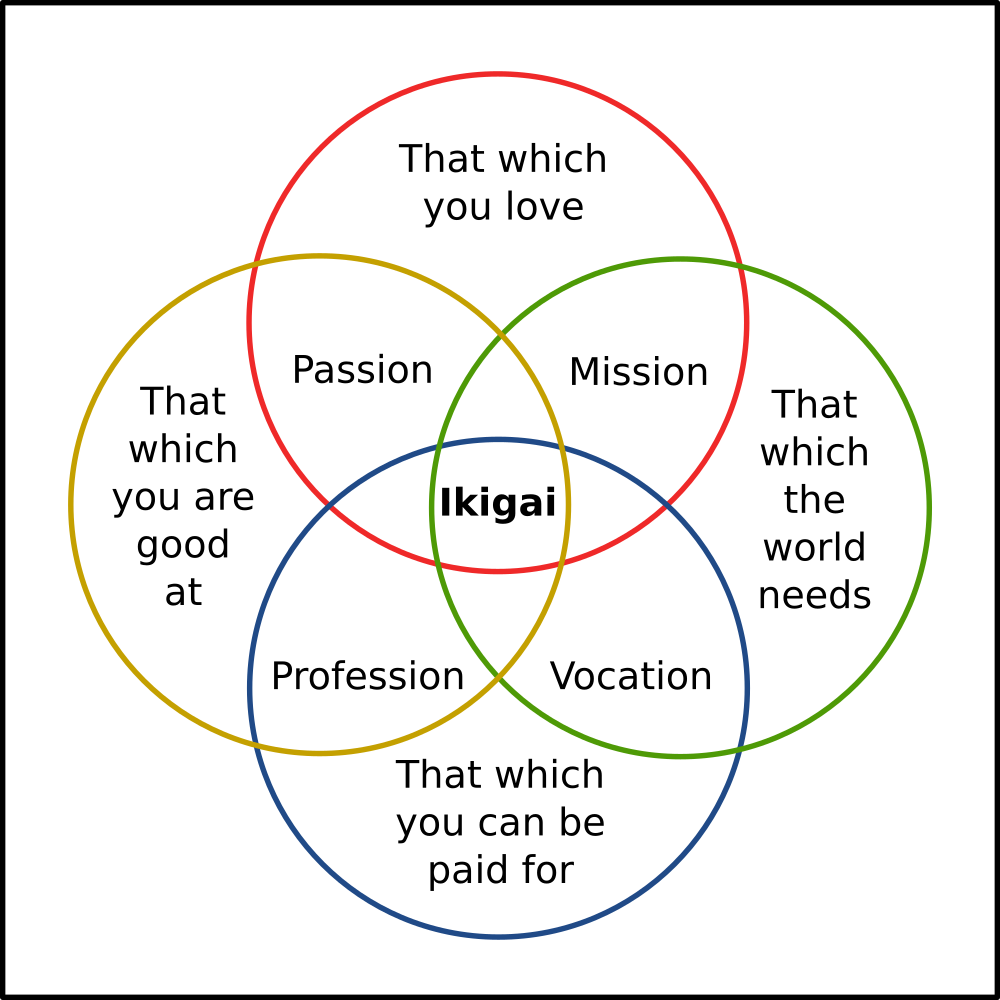
Japanese have a concept of fulfillment that they call Ikigai. It combines what you are good at, what you like doing, what is good for the World, and for what you could get money. We could illustrate that with the following Venn’s diagram: Ikigai appears where all those areas cross each other.

Ikigai as Venn's Diagram

To live a more fulfilling life, you might monetize one of your hobbies, find something likable in your current work activities, market what you are already doing to broader audiences, or find a niche where your products or services have a higher value. Don’t worry! Everyone’s situation and maturity are different. Maybe you won’t have your Ikigai in your twenties but will live your full potential in your fifties.

But how to find the thing about which you are genuinely passionate and would like to continue working on it if you do a lot of different joyful activities? What is the one true calling that would describe the deepest you?

One way to find that is to use the prioritizer – 1st things 1st, that I built to help people crystallize their thoughts and choices.

Using 1st things 1st to clarify your Ikigai

At 1st things 1st, you have something to prioritize and criteria by which to evaluate. When you rate each item by each measure, the tool calculates and sorts the elements from the most important to the least one.

Criteria

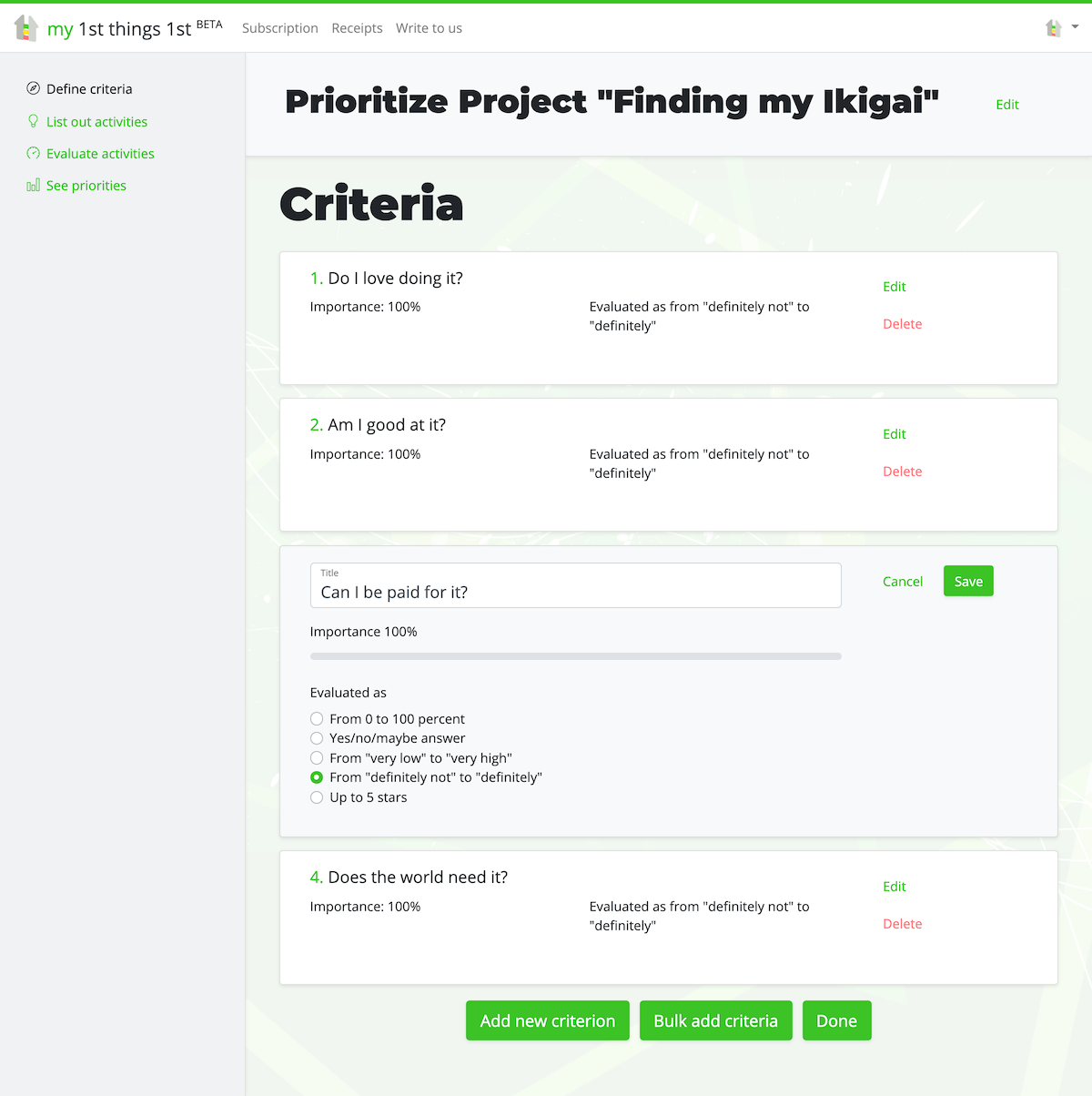
In the case of the searching of your Ikigai, you could have these criteria:

  • Do I love doing it?
  • Am I good at it?
  • Can I be paid for it?
  • Does the world need it?
Ikigai: define your criteria

There is a project template for that.

Activities

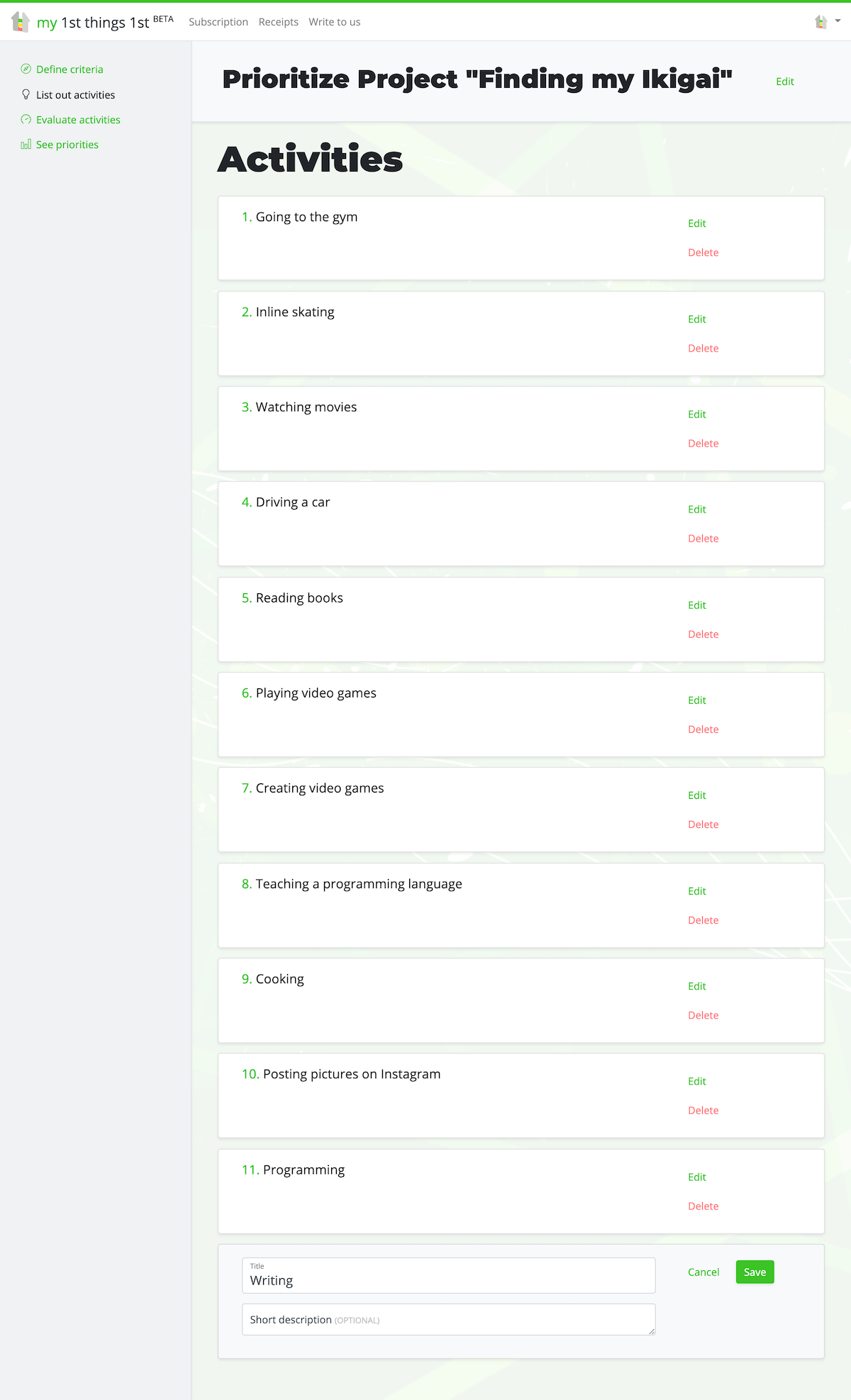
Then you would add all the activities that you have ever done that are very specific to you. Remember things from selling ice cream on the beach at your childhood to carving wooden figures in your free time, from enjoying movies on Netflix to visiting far-away secret locations of the World.

Ikigai: list out your activities

Evaluations

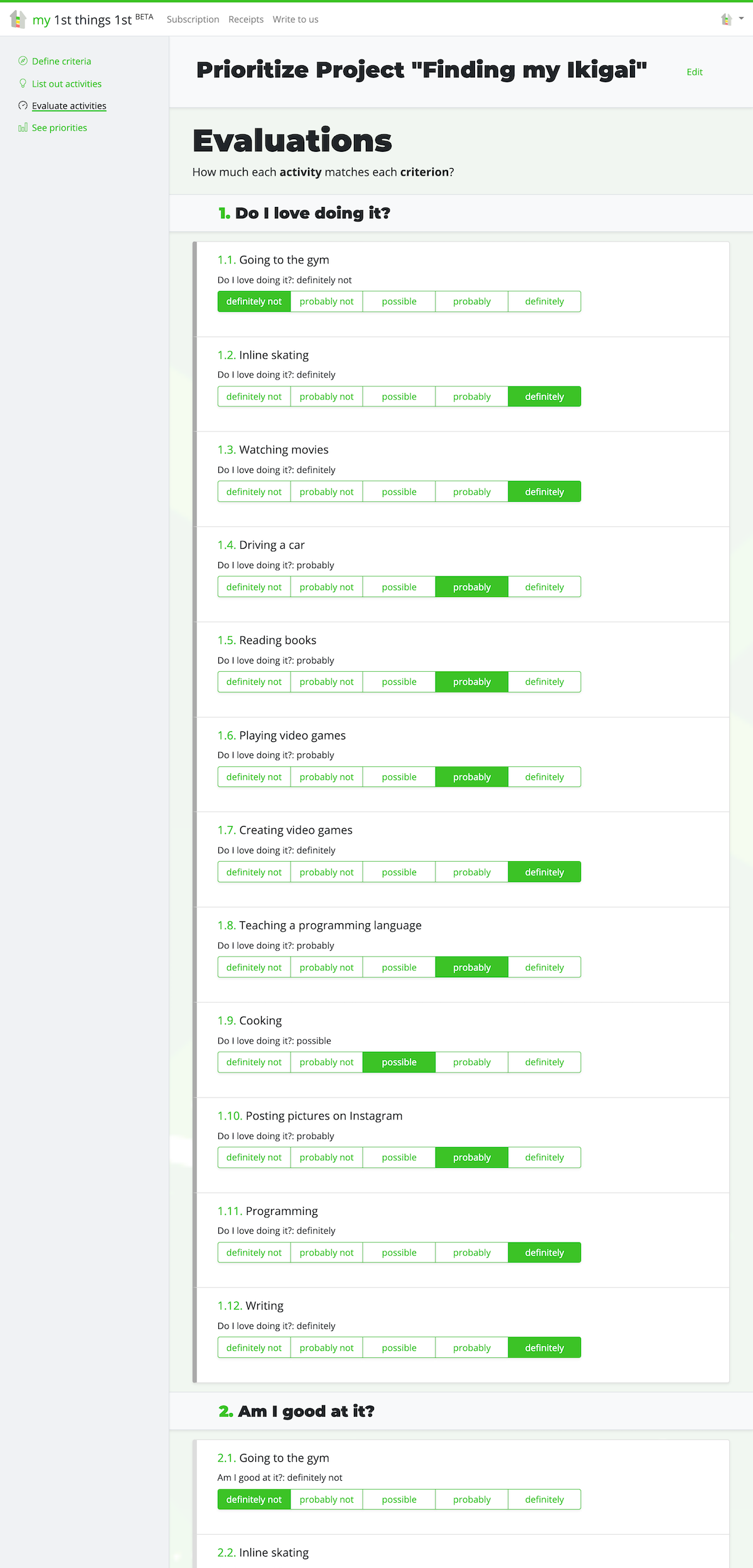
The next step would be to rate the activities by each criterion. For each activity, you would answer those questions with answers like:

  • definitely
  • probably
  • possible
  • probably not
  • definitely not

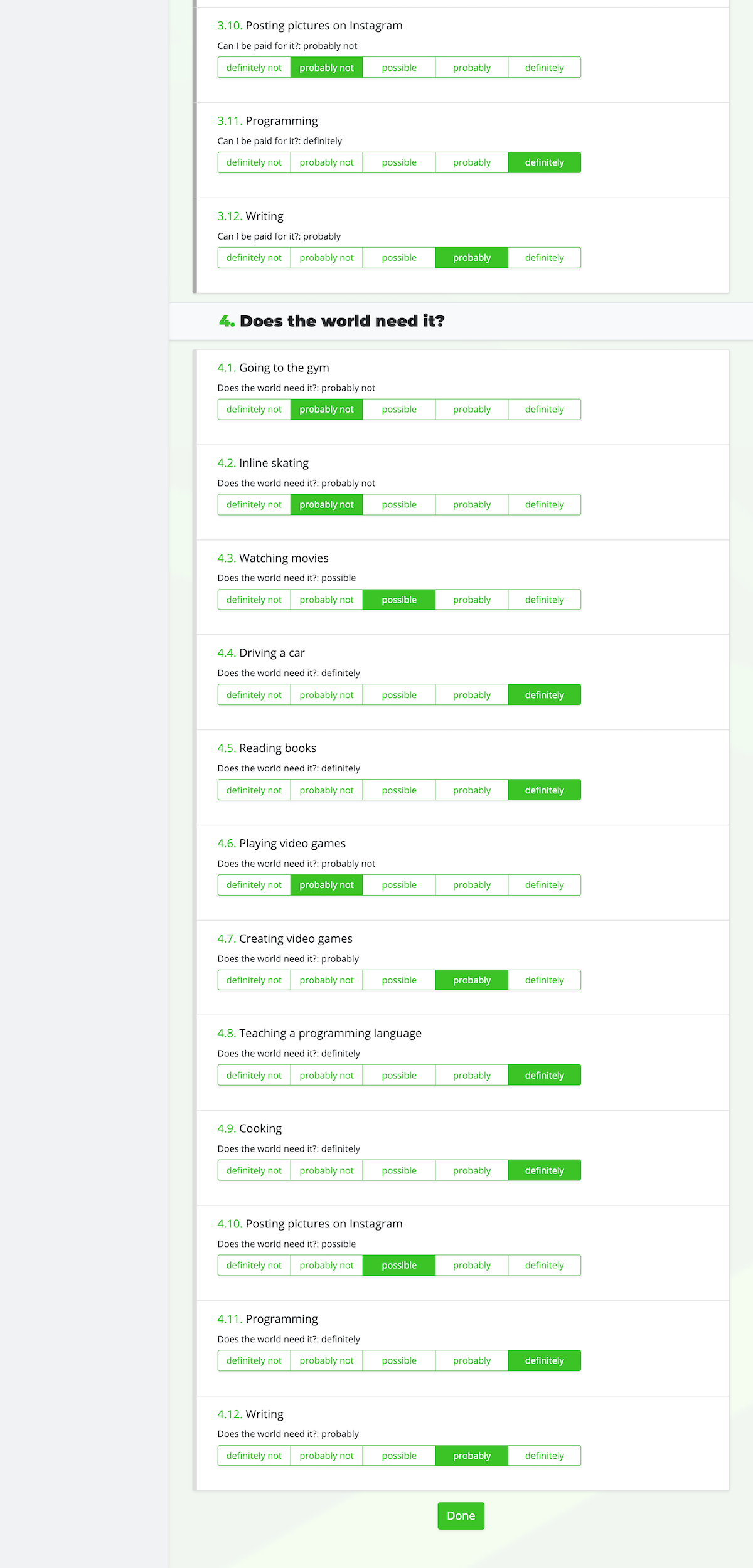
Only you know what you like doing most and how good you are at that. Be open-minded and creative when deciding how much the World needs your activities and how much profit you could get out of it. In the age of the Web, there are many more possibilities than before.

Ikigai: evaluate your activities

Ikigai: evaluate your activities (continued)

If you don’t agree with my evaluations, that’s OK. You would evaluate your activities according to your worldview.

Priorities

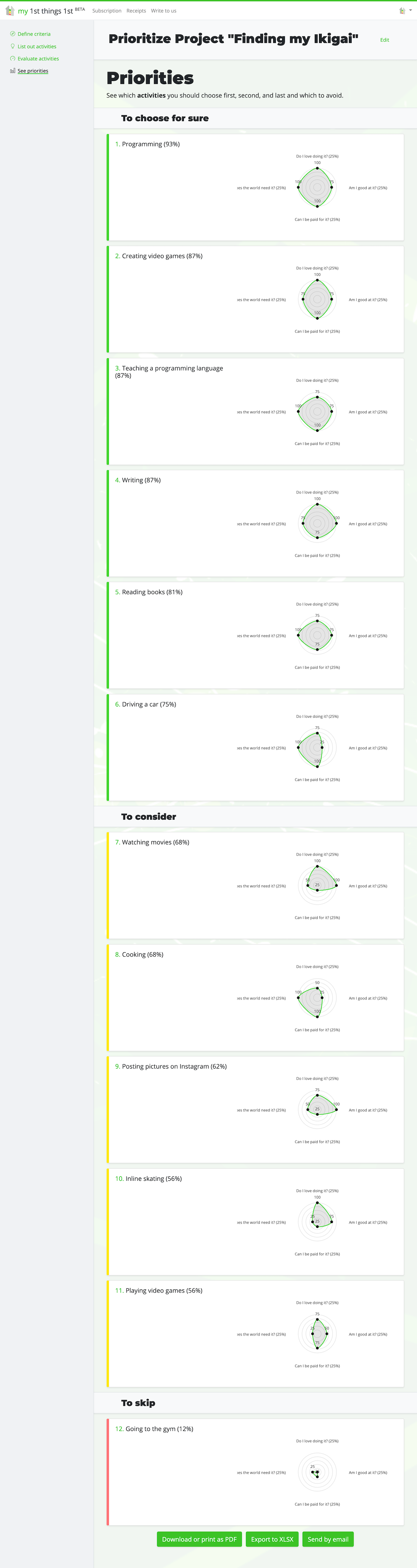
And then it would be the time to unveil your Ikigai. In the end, the tool would list you out the most valuable activities on which you should proceed to work.

For example, according to my choices and evaluations, my Ikigai is programming and writing. It is one of the reasons why I write this and other blogs, published a book about programming with the Django framework, and work on web projects.

Ikigai: choose your Ikigai

Let me help you to find the meaning of your life at www.1st-things-1st.com.


Cover photo by Content Pixie